Income Strategy • Covered Calls • MSFT

Covered Call Options Strategy for MSFT

Generate income on Microsoft stock by selling covered calls against your MSFT position.

MSFT Market Snapshot

Metric Value
52W Range $356.28 - $555.45
EPS $13.64
P/E 24.68
Div / Yield $3.48 / 0.84%
Liquidity Very Liquid
IV Rank 43/100
Earnings Jul 29, 2026 PM
1M Outlook Bullish
6M Outlook Neutral
Relative Strength 2/10
Volume 28.03M

Strategy Metrics

Metric Value
Premium Income / Net Credit $292.50
Max Reward $4,965.50
Max Risk $41,034.50
Annualized / Raw Return 5.93% / 0.71%
12M Projected Yield 6.77%
POW 87.18%
Breakeven $410.35
Days to Expiry 45

Implementation note: Use table markup for these fields where possible. It is easier for users to scan and gives search engines clear metric/value relationships.

MSFT Covered Call Payoff

A simple payoff view helps traders understand the income received, the breakeven level, and where upside becomes capped.
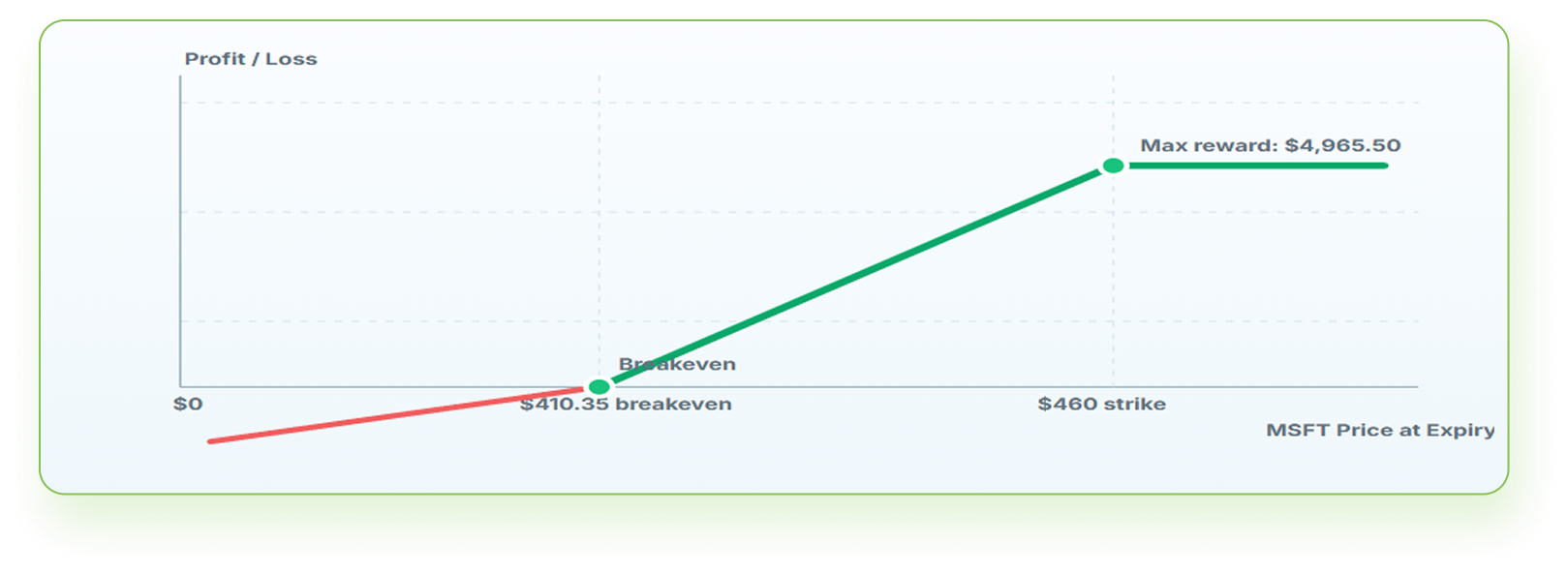
This is a bullish strategy with limited risk and limited potential reward. The strategy generates upfront income from the option premium, while upside is capped above the $460 strike price.

MSFT Covered Call Payoff

Sample Covered Call Opportunities

Ticker Strategy Expiry Strike Yield POW
MSFT Covered Call Jun 18, 2026 $460 0.71% 87.18%
AAPL Covered Call Dynamic Dynamic Dynamic Dynamic
NVDA Covered Call Members only Members only Members only Members only
AMZN Covered Call Members only Members only Members only Members only

Get daily covered call trade recommendations.

Sign up to unlock the full list, strategy details, and ongoing trade ideas from OptionsPlay.

SIGN UP NOW

Covered Call FAQs

Use these answers to learn what covered calls are, how they generate income, how to find high-yielding covered calls, and what risks to consider before trading.

A covered call is an options strategy where you own at least 100 shares of a stock and sell a call option against those shares. The call gives the buyer the right to purchase your shares at a set strike price before expiration. Because you already hold the shares, the position is "covered" — you can deliver them if assigned without buying at market price.

When you sell a call option, you collect a premium upfront — this is the income. You keep that premium regardless of what happens to the stock. If the option expires worthless, you keep your shares and the full premium, and can repeat the process to generate recurring cash flow on top of any dividends.

Beyond premium, consider the stock's quality and outlook, implied volatility, liquidity of the options chain, the strike's distance from the current price, upcoming earnings or events, and your downside risk. A high premium often signals higher risk, so balance yield against the chance of a large stock decline or early assignment.

The best candidates are typically stable, liquid stocks or ETFs you're comfortable holding long term, with active options markets and moderate-to-healthy implied volatility. Many investors favor large-cap names and broad index ETFs because they offer reliable premiums without the extreme swings of speculative stocks.

Use a covered call screener to filter by yield, expiration, strike distance, and downside protection. Screeners rank opportunities by annualized return and let you compare risk-adjusted premiums across hundreds of stocks quickly, instead of checking option chains one by one.

It depends on your strategy. Many income investors sell calls on a weekly or monthly cycle, rolling into a new contract after each expiration. Shorter durations capture faster time decay and more frequent income, while longer durations require less management. Your choice should match your time commitment and market view.

Strike price determines your trade-off between income and upside: closer-to-the-money strikes pay more premium but cap gains sooner, while further out-of-the-money strikes leave more room to grow. For expiration, 30–45 days is popular because time decay accelerates in that window. Align both with your outlook and how willing you are to have your shares called away.

A covered call screener is a tool that scans the market for covered call opportunities and ranks them by metrics like premium yield, annualized return, downside protection, and probability of assignment. It saves time by surfacing the trades that best fit your income goals and risk tolerance.

The two main risks are capped upside and downside exposure. If the stock rallies far above your strike, your gains are limited to the strike plus premium. If the stock falls, the premium offers only modest cushion — you still bear most of the loss on the shares. Covered calls reduce, but do not eliminate, the risk of owning the stock.

If your call is assigned, you sell your 100 shares per contract at the strike price and keep the premium. This usually happens when the stock closes above the strike at expiration. You realize the gain up to the strike plus the premium, but miss any further upside. You can then redeploy the cash or buy back in.

Rolling means buying back your current call and selling a new one with a later expiration and/or different strike. Investors often roll when the stock approaches the strike and they want to keep their shares, to collect more premium, or to avoid assignment before a dividend or event. Roll up for more upside, or out for more time and income.

Selling calls before earnings can pay larger premiums because implied volatility rises ahead of the report. The trade-off is sharply higher risk: a big earnings move can push the stock through your strike or cause a steep drop. Only sell into earnings if you accept that elevated volatility and are comfortable with the possible outcomes.

Analyze MSFT Covered Calls, Stock Data, and Options Metrics in One Place

Use this section to introduce the full OptionsPlay dashboard experience after the covered call education and FAQs.
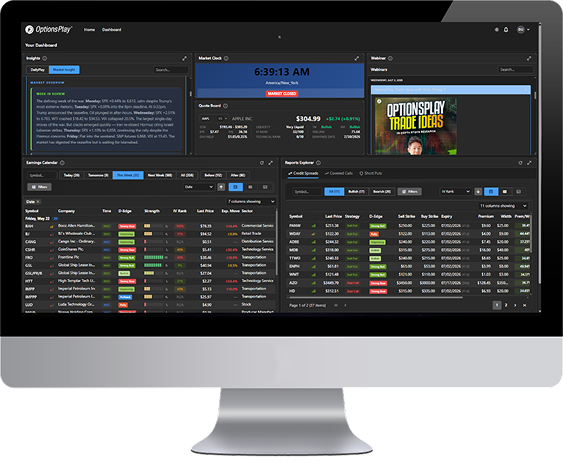
What the OptionsPlay dashboard can help users do

Dashboard area

What users can do

Daily trade ideas

Review curated options opportunities and quickly compare income, risk, reward, and probability metrics.

Strategy comparison

Evaluate covered calls, cash-secured puts, spreads, and other strategies side by side before choosing a trade.

Market research

Use stock outlook, volatility, earnings, liquidity, and technical signals to understand whether a trade fits the current setup.

Watchlists and alerts

Track symbols, monitor opportunities, and stay informed when key market or options conditions change.

Education and coaching

Connect trade ideas back to webinars, courses, live coaching, and platform walkthroughs so users can keep learning.