
Your Trial Playbook
The Complete Trial Video Library
Start with why consistency is so hard, then work through all four teaching sessions: sizing and risk, managing a trade, and pressing your winners.
Why Consistency Is So Hard, and What Actually Fixes It
Before any of the sessions that follow, the honest explanation of why trading stays frustrating for capable people, and the path that isn’t another strategy, indicator, or guru.
The Gap Nobody Talks About
Almost everyone who trades arrives at the same strange place. You’ve done the work. You’ve read the books, sat through the courses, followed people who clearly know what they’re doing. You’ve had trades that worked exactly the way you called them. You can look at a chart and see something real.
And yet the account doesn’t compound the way it feels like it should.
That gap is the hardest part of trading, and it has very little to do with intelligence or effort. Being right often enough to know you’re capable, while the results stay flat, is genuinely exhausting. It is also the point where most people quietly decide they aren’t cut out for this and walk away. If that experience is familiar, it isn’t a verdict on you. It is the single most common experience in trading, and it has a specific cause.
It Was Never a Knowledge Problem
Open any feed and someone is marketing the answer. A new strategy. A new indicator. A service, a room, a system, usually alongside screenshots of their own results and the implication that following them closely enough will produce the same outcome for you.
The premise underneath all of it is that the missing piece is one more idea.
After 18 years working with thousands of retail and institutional traders, that premise does not hold up. Retail traders today often have access to as much data, as much research, and as many ideas as professionals do. The shortage was never ideas. Anyone who has traded for any length of time has a folder full of ideas that were correct and still didn’t make money.
What Actually Separates Profitable Traders
What consistently delivers is far less exciting than a secret strategy, which is exactly why it doesn’t get marketed to you. It is a repeatable process for turning an idea into a well-structured trade, sizing it correctly, and managing it without guessing.
Three decisions, made the same way every time. That is the whole thing.
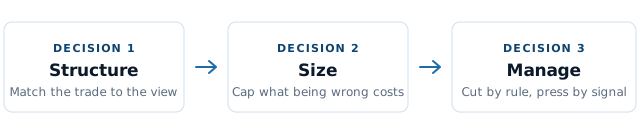
The entire process. Three decisions, made the same way every time.
It sounds too plain to be the answer until you look at the math. Even good traders are right somewhere in the 56 to 60% range, not 80%. Across our own DailyPlay portfolio, roughly 21% of trades produced more than 95% of total profits, while the other 79% netted out close to zero. Nobody knows at entry which trade will be which. What determines the outcome is whether the ordinary trades stayed small and disciplined, and whether the exceptional ones were pressed when they appeared.
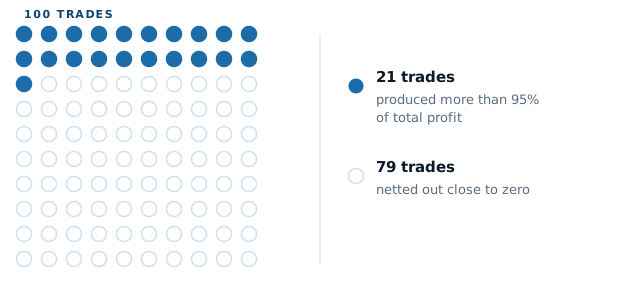
Nobody knows at entry which trade will be which. That is why the process, not the pick, decides the outcome.
If the difference were raw skill or a proprietary secret, there would be very little you could do about it. Process is different. It is mechanical, it is learnable, and it works the same way for a $10,000 account as it does for a $10 million one.
What the Next Two Weeks Look Like
Finding and choosing ideas. Moving from searching thousands of names to choosing from a short list that has already been filtered and ranked for you.
Sizing and protecting downside. The part almost no trading education covers, and the clearest line between professionals and everyone else.
Managing what you hold. The three emotional traps every open position falls into, why winning trades can still lose money, and what to do with a position that is proving you right.
Each session below has a video and a written version. Work through them in order if you can, since each one builds on the last.
The Honest Promise
We are not going to tell you that this makes you right more often. Nothing does, and anyone claiming otherwise is selling something. What a process does is make sure that being right actually pays you, and that being wrong costs you what you agreed it would cost. That is what puts a trader on the path to profitability, and it is what the rest of this trial is built to teach you.
The One Mistake That Wrecks Every Trader
Why protecting your downside, not finding better ideas, is the single clearest line between professional traders and everyone else.
The Part of Trading Everyone Skips
Most trading education focuses on indicators, strategy, and finding better ideas. Almost none of it focuses on risk management. Yet after 18 years of working with retail and institutional traders, this is the single clearest line between professional traders and everyone else. Get downside protection wrong, and nothing else you do matters, because you won’t survive long enough to benefit from it.
Finite Games vs. Infinite Games
A useful reframe comes from a concept popularized decades ago: the difference between finite and infinite games. Finite games (chess, football, basketball) have fixed rules and a clear winner at the end. Infinite games (a career, a business, a marriage) have no fixed endpoint. There are only players and dropouts: either you have the resources to keep playing, or you don’t.
Trading is an infinite game, but most people approach it like a finite one, focused on “winning” each trade. Once you accept that there’s no such thing as winning at trading, only staying in it, the goal shifts entirely: your only job is to protect your ability to trade another day.
The Math of a Drawdown
Losses and the gains required to recover from them grow exponentially, and human beings are consistently bad at estimating that curve.
Once a drawdown passes roughly 25–30%, the gain required to get back to even becomes hard to achieve through trading alone. That threshold is one of the most important lines to stay inside of, and staying inside of it comes down to one habit: keeping every individual trade small.
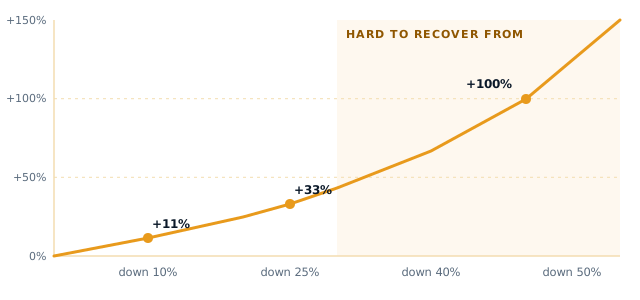
The gain needed to get back to even does not rise in a straight line. Past roughly 25 to 30%, it starts running away from you.
The 2% Rule
Risking no more than about 2% of total account value per trade means you could survive 10 consecutive losing trades and still recover with roughly 13 winning trades. Risk 5% per trade instead, and that same losing streak requires 20 winning trades just to break even, close to mathematically impossible for most strategies.
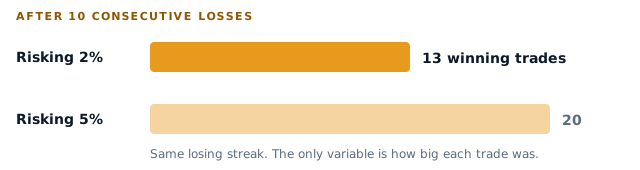
Position size is what decides whether a bad run is survivable or terminal.
The Risk and Investment Calculator inside OptionsPlay applies this automatically: set your portfolio value once in your Profile, and every trade you evaluate afterward shows you exactly how many contracts keep you within your risk limit. It takes one click and no mental math, which matters because this decision should happen before you’re in the trade, before live P&L starts pulling at your emotions.
What Actually Separates Professionals From Retail Traders
It isn’t better data, a Bloomberg terminal, or a secret strategy. Retail traders often have access to as much or more than professionals do. The real difference is that professional traders have risk limits imposed on them by their employer, and breaking those limits gets them fired. Retail traders have the exact same math available to them, but following it is entirely optional, and under the stress of a live position, discipline is often the first thing to go.
Three Rules for Every Trade
Set a stop before you enter. Decide, in advance and in writing, at what point the trade thesis is no longer valid. When the moment comes, it’s a simple yes-or-no check against a line you already drew, not a decision made under emotional pressure.
Size every trade to about 2% of your account. This is what makes rule one actually followable. Traders who size too big become what poker players call “pot committed”, unable to admit a loss because they can’t afford it, so they hold and hope instead.
Cut it at the stop, no exceptions. Black and white: either the level has been crossed or it hasn’t. No negotiation once it has.
Why This Comes First
Protecting downside won’t make you profitable on its own. It’s the prerequisite that makes everything else possible. OptionsPlay’s own DailyPlay signals carry roughly a 56% win rate on the initial pick, a fairly ordinary number by market standards, yet the portfolio has outperformed the S&P 500 by a wide margin over time. That gap comes entirely from process, not prediction. That’s the subject of the next session.
Managing losing trades should require almost no mental capital: the rules are completely objective. Managing winning trades is where real judgment is needed, so protect that mental capital by keeping the downside decisions mechanical.
How to Manage a Trade and Review the Decision
The three emotional traps every open position falls into, and the rules that keep each one from draining your mental capital.
Where the Emotional Drain Actually Happens
Finding a trade idea can be mentally tiring, but it isn’t particularly emotional. The emotional drain starts once you’re actually in a position, because every price tick is another opportunity to ask: should I stay in? Get out? Take profits? Cut losses? That repeated decision-making is what drains mental capital, a resource that deserves as much attention as financial capital, because poor decisions tend to follow when it runs out.
Every open trade sits in one of three states, and each one carries its own emotional trap.
The instinct is to hunt for a reason to stay in, because cutting means admitting you were wrong.
The rule: it either triggered its stop or it didn’t. If it did, close it.
The instinct is to lock in the win before it turns. Taking profits early is a leading cause of underperformance.
The rule: treat a fresh signal as a reason to add, not a reason to exit.
The hardest state to judge. Neither stop nor target hit, just stalled and quietly draining attention.
The rule: long premium, time is against you, so cut. Short premium, time is with you, so wait.
State One: The Ego Trap
When a trade moves against you, the instinct is to look for reasons to stay in it: a new indicator, a different timeframe, anything that justifies holding on. The real reason is simpler: cutting a loss means admitting you were wrong, and that’s uncomfortable. But even the best traders are wrong on roughly 40% of their trades. There’s almost no other profession where being wrong that often is still consistent with being excellent at the job.
The fix is to make the decision non-negotiable: either the position has triggered its stop-loss rule or it hasn’t. If it has, close it. This should be one of the easiest, least emotional decisions in your whole process, and it stays that way only if the trade was sized correctly to begin with. A trade sized too large makes cutting the loss much more painful, which is exactly when discipline breaks down.
State Two: The Conviction Trap
When a trade moves in your favor, the instinct is the opposite: lock in the win before it turns back into a loss. “You can’t go broke taking profits” is one of the most repeated, and most damaging, ideas in trading. Taking profits too early is one of the leading causes of underperformance, because if 30–40% of trades are going to be losers no matter what, the only way to offset them is with a small number of much bigger winners.
The uncomfortable but correct move is to add exposure to a position that’s already working, not fewer chips on the table, more. Recent examples include Rocket Lab, entered on May 11th, added to again on May 19th and once more the following day as each new signal confirmed the trend; and similar sequences in Applied Materials, Dell, and Alphabet. In each case, a new buy signal on an already-profitable position was treated as an opportunity to press, not a reason to take profits and walk away.
State Three: The Mental Capital Trap
The hardest state to judge is a trade that’s neither hit its stop nor its target. It’s just stalled. Here, the key question is whether you’re long or short premium. If you’re long premium, time is working against you, and theta will keep eroding the position the longer it goes nowhere. The disciplined response is usually to cut it and reallocate to a better setup. If you’re short premium, time is on your side, and there’s more room to let the original thesis play out.
Either way, this requires going back to why you entered the trade in the first place and asking, objectively, whether that reason still holds. Writing the original thesis down when you enter a trade makes this a much easier question to answer later.
The Numbers Behind the Rules
The trades that were added to as they proved themselves correct made up roughly 32% of total exposure, and accounted for 55% of total profit. Standalone wins, in comparison, contributed the remaining 45%. The pattern holds across specific names: Micron was added to three times, Alphabet three times, Caterpillar once on a breakout, and those handful of positions did the heavy lifting for the whole portfolio.
A Daily Order of Operations
Each morning, work through positions in this order: first, clear out anything that’s hit its stop loss. This should take no mental effort and no debate. Second, spend the bulk of your attention on winning positions, deciding which ones deserve more exposure. Third, review stalled trades and decide whether the original thesis still holds. Only after all three should you look at brand-new opportunities for the day. Protecting existing exposure always comes before chasing something new.
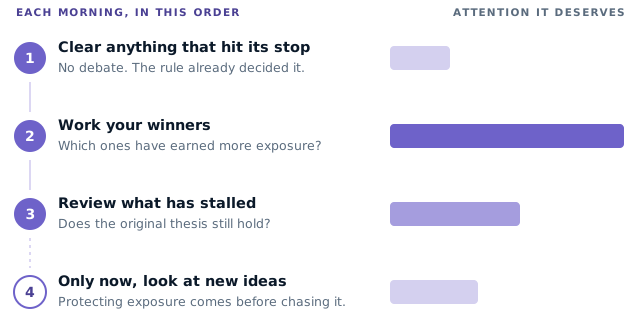
Most traders run this list upside down, starting with new ideas and getting to their open positions last.
Why You Win Trades but Still Lose Money
It’s not your indicators or your ideas. It’s two behaviors, and the data behind why they matter more than everything else combined.
You’re Probably Focused on the Wrong Thing
Most traders spend years searching for a better indicator, a better subscription service, a better strategy, convinced that the right combination will finally deliver consistent profitability. After 18 years working with thousands of retail and institutional traders, the pattern is consistent: none of that is what actually separates profitable traders from everyone else. It’s behavior.
What Profitable Trading Actually Looks Like
Most people picture a profitable account as a smooth, steadily rising line. Real profitable accounts rarely look like that. They can stay essentially flat for weeks or even months at a time, punctuated by a small handful of trades, usually 10–15% of the total, that account for the vast majority of the gains. When traders expect the smooth version and get the choppy, flat reality instead, many conclude their strategy is broken and abandon it right before it would have worked.
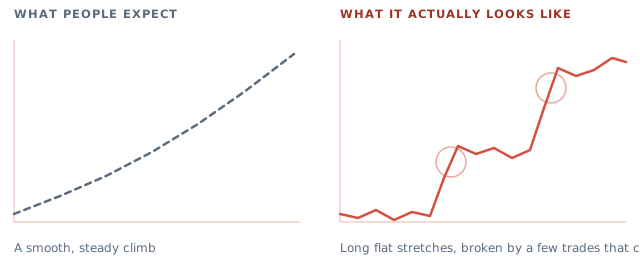
When traders expect the left chart and live through the right one, many conclude the strategy is broken and quit just before it works.
Two Behaviors, Not Two Hundred Indicators
At the moment you enter any trade, there’s nothing that tells you whether it will be a small win, a small loss, or a huge win. Reaching profitability comes down to staying disciplined across two specific behaviors.
Survive the ordinary. Roughly 80% of trades are just that: ordinary. Small wins and small losses that largely net out. Staying disciplined here means not deviating from your sizing rules just because an idea feels unusually compelling.
Press the exceptional. When a trade proves itself correct, that’s the moment to add more exposure, not to take profits and move on. This is the harder of the two, because it happens rarely and goes against every instinct.
The Numbers
Across the DailyPlay portfolio, just 21% of trades, the ones that were added to after proving themselves, produced more than 95% of total profits. A single Alphabet trade, built up over three separate adds, accounted for nearly 25% of total gains on its own. The remaining roughly 79% of trades net out close to zero. The only way that math works is if the 80% stay small and disciplined, and the rare exceptional trades are pressed hard when they show up.
Sizing Is What Makes Any of This Survivable
None of this works if a single bad idea can blow up the account. The Risk and Investment Calculator inside OptionsPlay handles the math automatically: set a portfolio value and a 2% default in your Profile, and every trade afterward tells you exactly how many contracts keep you inside that limit. No mental math, no fatigue-driven mistakes at the point of placing an order.
Catching Moves Early Makes Pressing Them Easier
The earlier a winning position is caught, the easier it psychologically is to add to it later. Buying Oracle near its breakout at 175 made subsequent adds at 180, 195, and 225 feel like a natural extension of an already-confirmed thesis. Buying in cold at 225 would have made each further add feel like chasing. The Early Breakout Detector inside OptionsPlay is built specifically to surface these setups at the earliest, most tradable stage, before the move is obvious to everyone else.
This Week’s Practice
Pull your last 20–30 trades and look honestly at your win rate, your average win versus average loss, and what percentage of your total profit came from your top three trades. Understanding your own behavior is the first step toward changing it.
Why Cutting Winners Too Early Destroys Your Edge
The data behind why adding to a winning position, not finding the next idea, is where profitable trading actually comes from.
The Hardest Trade to Make
Adding to a position that’s already working is arguably the single most important skill separating consistently profitable traders from everyone else, and it’s also the hardest one to execute. Three things make it feel wrong: it feels like chasing a move that’s already happened, it feels like piling on extra risk, and there’s no exciting “new idea” story attached to it the way there is with a fresh position.
The Thanksgiving Analogy
Imagine two family members each pitch you a business at Thanksgiving, and you invest $10,000 in each. A year later, one business is thriving and one is struggling, and both ask for more money. Almost everyone would put more capital into the business that’s working, not the one that’s failing. Trading works exactly the same way. Yet the instinct with an open position is often the opposite. A stock bought at $100 that falls to $80 tempts traders to buy more because “it must be even cheaper now,” while a stock that runs from $100 to $120 tempts traders to sell and lock in the gain. Both instincts point capital toward the underperforming position and away from the one that’s actually proving itself correct.
The Data: From a Coin Flip to a Real Edge
Picking stocks at random from the S&P 500 is close to a coin flip. OptionsPlay’s technical signals move that to roughly 56%, a real but modest edge, and in line with what even the best backtested strategies tend to produce over the long run. But once a trade has already proven itself correct and a new position is added to it, the win rate on that second trade climbs to roughly 68%, and has been seen north of 80% during strong stretches of the market. The edge doesn’t come from finding a new idea. It comes from reinvesting in the idea that’s already working.
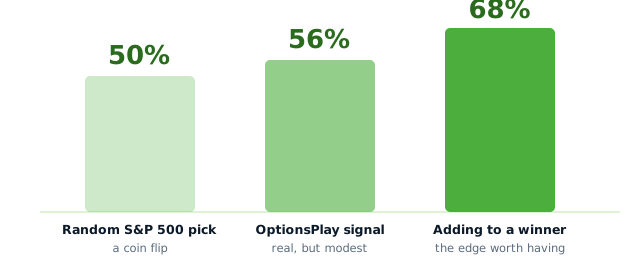
The edge does not come from finding a new idea. It comes from reinvesting in the one already proving you right.
What Adding to a Winner Actually Looks Like
Alphabet is a clean example: an early breakout signal on April 8th led to an initial credit spread. Once the stock confirmed the move into a confirmed-outperformer status about a week later, a debit spread was added. A third position followed on a pullback-driven buy signal on the 29th. Across four total opportunities to press the same thesis, roughly $2,000 of initial risk grew into a $6,600 gain.
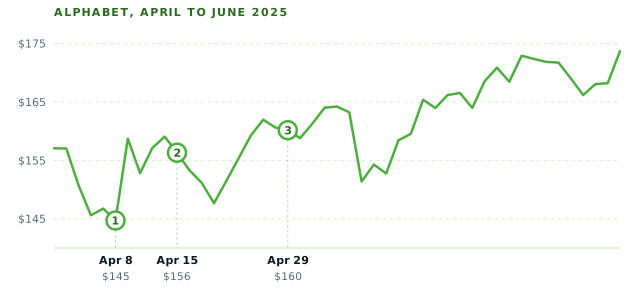
Each add came on a fresh signal from a position already proving the thesis correct, not on a new idea. Alphabet daily closes, April to June 2025.
Not every add works out. Broadcom was caught early on its own breakout and added to three times heading into an earnings report that came in far worse than expected, with the stock dropping sharply overnight. Even so, because the position had been built up with income already collected along the way, the total loss across $8,000 of risk was only about $3,000, and the trade would be taken again under the same setup, because the potential upside it was chasing outweighed the downside it risked. Across the full sample, wins from pressed positions outweighed losses from ones that didn’t work out by roughly 4 to 1.
Two Ways to Size an Add
Flat and fixed: deploy about 2% of the account on the initial trade, then another 2% each time a new signal confirms. Simple to follow, and a good starting point for anyone still building the habit.
Exponential: start smaller, around 1%, on the initial, exploratory position, then scale up faster as the thesis confirms: 1% → 3% → 5%. More experienced traders often prefer this because it risks less on the unconfirmed opening position and compounds faster once a trend is clearly working.
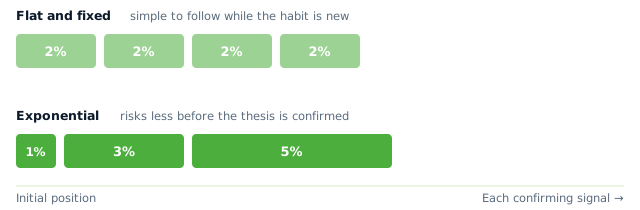
Two ways to scale into a position that is working. Both start small, neither adds to something that has not confirmed.
This Week’s Practice
Look through your current winning positions and check which ones have generated a fresh buy signal. Instead of taking profits, treat that signal the way you would a brand-new trade idea, and add. It will feel unnatural the first few times. That discomfort is not a sign you’re doing it wrong.
Ready to put this into practice?
Everything from these four sessions is already built into the platform: watchlists, the Strategy Builder, the Risk and Investment Calculator, stop and take-profit alerts, and the Early Breakout Detector.
Open the platform →