
Your Trial Playbook
The Complete Trial Video Library
Start with why consistency is so hard, then work through all four teaching sessions: sizing and risk, managing a trade, and pressing your winners.
Why Cutting Winners Too Early Destroys Your Edge
The data behind why adding to a winning position, not finding the next idea, is where profitable trading actually comes from.
The Hardest Trade to Make
Adding to a position that’s already working is arguably the single most important skill separating consistently profitable traders from everyone else, and it’s also the hardest one to execute. Three things make it feel wrong: it feels like chasing a move that’s already happened, it feels like piling on extra risk, and there’s no exciting “new idea” story attached to it the way there is with a fresh position.
The Thanksgiving Analogy
Imagine two family members each pitch you a business at Thanksgiving, and you invest $10,000 in each. A year later, one business is thriving and one is struggling, and both ask for more money. Almost everyone would put more capital into the business that’s working, not the one that’s failing. Trading works exactly the same way. Yet the instinct with an open position is often the opposite. A stock bought at $100 that falls to $80 tempts traders to buy more because “it must be even cheaper now,” while a stock that runs from $100 to $120 tempts traders to sell and lock in the gain. Both instincts point capital toward the underperforming position and away from the one that’s actually proving itself correct.
The Data: From a Coin Flip to a Real Edge
Picking stocks at random from the S&P 500 is close to a coin flip. OptionsPlay’s technical signals move that to roughly 56%, a real but modest edge, and in line with what even the best backtested strategies tend to produce over the long run. But once a trade has already proven itself correct and a new position is added to it, the win rate on that second trade climbs to roughly 68%, and has been seen north of 80% during strong stretches of the market. The edge doesn’t come from finding a new idea. It comes from reinvesting in the idea that’s already working.
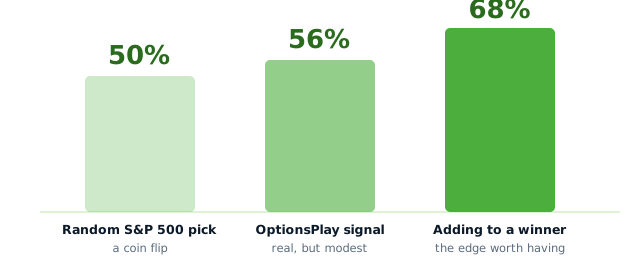
The edge does not come from finding a new idea. It comes from reinvesting in the one already proving you right.
What Adding to a Winner Actually Looks Like
Alphabet is a clean example: an early breakout signal on April 8th led to an initial credit spread. Once the stock confirmed the move into a confirmed-outperformer status about a week later, a debit spread was added. A third position followed on a pullback-driven buy signal on the 29th. Across four total opportunities to press the same thesis, roughly $2,000 of initial risk grew into a $6,600 gain.
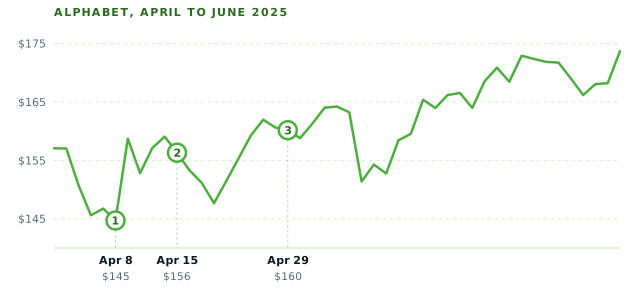
Each add came on a fresh signal from a position already proving the thesis correct, not on a new idea. Alphabet daily closes, April to June 2025.
Not every add works out. Broadcom was caught early on its own breakout and added to three times heading into an earnings report that came in far worse than expected, with the stock dropping sharply overnight. Even so, because the position had been built up with income already collected along the way, the total loss across $8,000 of risk was only about $3,000, and the trade would be taken again under the same setup, because the potential upside it was chasing outweighed the downside it risked. Across the full sample, wins from pressed positions outweighed losses from ones that didn’t work out by roughly 4 to 1.
Two Ways to Size an Add
Flat and fixed: deploy about 2% of the account on the initial trade, then another 2% each time a new signal confirms. Simple to follow, and a good starting point for anyone still building the habit.
Exponential: start smaller, around 1%, on the initial, exploratory position, then scale up faster as the thesis confirms: 1% → 3% → 5%. More experienced traders often prefer this because it risks less on the unconfirmed opening position and compounds faster once a trend is clearly working.
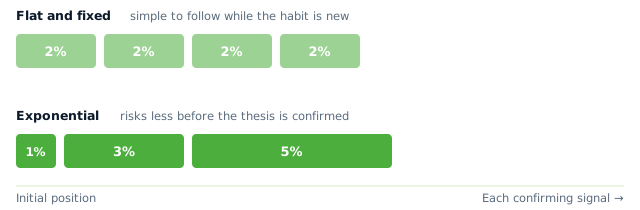
Two ways to scale into a position that is working. Both start small, neither adds to something that has not confirmed.
This Week’s Practice
Look through your current winning positions and check which ones have generated a fresh buy signal. Instead of taking profits, treat that signal the way you would a brand-new trade idea, and add. It will feel unnatural the first few times. That discomfort is not a sign you’re doing it wrong.
Ready to put this into practice?
Everything from these four sessions is already built into the platform: watchlists, the Strategy Builder, the Risk and Investment Calculator, stop and take-profit alerts, and the Early Breakout Detector.
Open the platform →