
Your Trial Playbook
The Complete Trial Video Library
Start with why consistency is so hard, then work through all four teaching sessions: sizing and risk, managing a trade, and pressing your winners.
Why You Win Trades but Still Lose Money
It’s not your indicators or your ideas. It’s two behaviors, and the data behind why they matter more than everything else combined.
You’re Probably Focused on the Wrong Thing
Most traders spend years searching for a better indicator, a better subscription service, a better strategy, convinced that the right combination will finally deliver consistent profitability. After 18 years working with thousands of retail and institutional traders, the pattern is consistent: none of that is what actually separates profitable traders from everyone else. It’s behavior.
What Profitable Trading Actually Looks Like
Most people picture a profitable account as a smooth, steadily rising line. Real profitable accounts rarely look like that. They can stay essentially flat for weeks or even months at a time, punctuated by a small handful of trades, usually 10–15% of the total, that account for the vast majority of the gains. When traders expect the smooth version and get the choppy, flat reality instead, many conclude their strategy is broken and abandon it right before it would have worked.
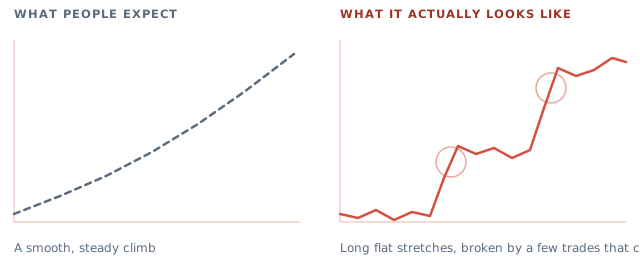
When traders expect the left chart and live through the right one, many conclude the strategy is broken and quit just before it works.
Two Behaviors, Not Two Hundred Indicators
At the moment you enter any trade, there’s nothing that tells you whether it will be a small win, a small loss, or a huge win. Reaching profitability comes down to staying disciplined across two specific behaviors.
Survive the ordinary. Roughly 80% of trades are just that: ordinary. Small wins and small losses that largely net out. Staying disciplined here means not deviating from your sizing rules just because an idea feels unusually compelling.
Press the exceptional. When a trade proves itself correct, that’s the moment to add more exposure, not to take profits and move on. This is the harder of the two, because it happens rarely and goes against every instinct.
The Numbers
Across the DailyPlay portfolio, just 21% of trades, the ones that were added to after proving themselves, produced more than 95% of total profits. A single Alphabet trade, built up over three separate adds, accounted for nearly 25% of total gains on its own. The remaining roughly 79% of trades net out close to zero. The only way that math works is if the 80% stay small and disciplined, and the rare exceptional trades are pressed hard when they show up.
Sizing Is What Makes Any of This Survivable
None of this works if a single bad idea can blow up the account. The Risk and Investment Calculator inside OptionsPlay handles the math automatically: set a portfolio value and a 2% default in your Profile, and every trade afterward tells you exactly how many contracts keep you inside that limit. No mental math, no fatigue-driven mistakes at the point of placing an order.
Catching Moves Early Makes Pressing Them Easier
The earlier a winning position is caught, the easier it psychologically is to add to it later. Buying Oracle near its breakout at 175 made subsequent adds at 180, 195, and 225 feel like a natural extension of an already-confirmed thesis. Buying in cold at 225 would have made each further add feel like chasing. The Early Breakout Detector inside OptionsPlay is built specifically to surface these setups at the earliest, most tradable stage, before the move is obvious to everyone else.
This Week’s Practice
Pull your last 20–30 trades and look honestly at your win rate, your average win versus average loss, and what percentage of your total profit came from your top three trades. Understanding your own behavior is the first step toward changing it.
Ready to put this into practice?
Everything from these four sessions is already built into the platform: watchlists, the Strategy Builder, the Risk and Investment Calculator, stop and take-profit alerts, and the Early Breakout Detector.
Open the platform →