
Your Trial Playbook
The Complete Trial Video Library
Start with why consistency is so hard, then work through all four teaching sessions: sizing and risk, managing a trade, and pressing your winners.
The One Mistake That Wrecks Every Trader
Why protecting your downside, not finding better ideas, is the single clearest line between professional traders and everyone else.
The Part of Trading Everyone Skips
Most trading education focuses on indicators, strategy, and finding better ideas. Almost none of it focuses on risk management. Yet after 18 years of working with retail and institutional traders, this is the single clearest line between professional traders and everyone else. Get downside protection wrong, and nothing else you do matters, because you won’t survive long enough to benefit from it.
Finite Games vs. Infinite Games
A useful reframe comes from a concept popularized decades ago: the difference between finite and infinite games. Finite games (chess, football, basketball) have fixed rules and a clear winner at the end. Infinite games (a career, a business, a marriage) have no fixed endpoint. There are only players and dropouts: either you have the resources to keep playing, or you don’t.
Trading is an infinite game, but most people approach it like a finite one, focused on “winning” each trade. Once you accept that there’s no such thing as winning at trading, only staying in it, the goal shifts entirely: your only job is to protect your ability to trade another day.
The Math of a Drawdown
Losses and the gains required to recover from them grow exponentially, and human beings are consistently bad at estimating that curve.
Once a drawdown passes roughly 25–30%, the gain required to get back to even becomes hard to achieve through trading alone. That threshold is one of the most important lines to stay inside of, and staying inside of it comes down to one habit: keeping every individual trade small.
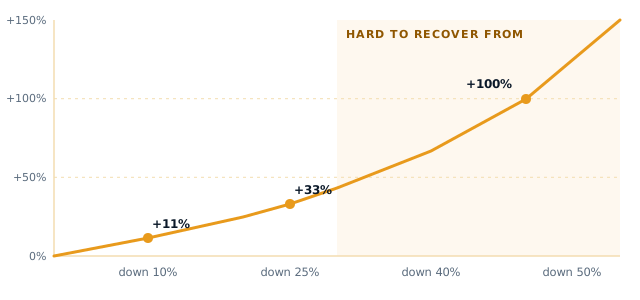
The gain needed to get back to even does not rise in a straight line. Past roughly 25 to 30%, it starts running away from you.
The 2% Rule
Risking no more than about 2% of total account value per trade means you could survive 10 consecutive losing trades and still recover with roughly 13 winning trades. Risk 5% per trade instead, and that same losing streak requires 20 winning trades just to break even, close to mathematically impossible for most strategies.
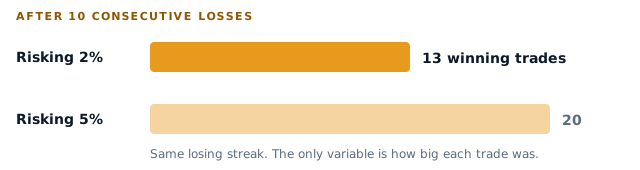
Position size is what decides whether a bad run is survivable or terminal.
The Risk and Investment Calculator inside OptionsPlay applies this automatically: set your portfolio value once in your Profile, and every trade you evaluate afterward shows you exactly how many contracts keep you within your risk limit. It takes one click and no mental math, which matters because this decision should happen before you’re in the trade, before live P&L starts pulling at your emotions.
What Actually Separates Professionals From Retail Traders
It isn’t better data, a Bloomberg terminal, or a secret strategy. Retail traders often have access to as much or more than professionals do. The real difference is that professional traders have risk limits imposed on them by their employer, and breaking those limits gets them fired. Retail traders have the exact same math available to them, but following it is entirely optional, and under the stress of a live position, discipline is often the first thing to go.
Three Rules for Every Trade
Set a stop before you enter. Decide, in advance and in writing, at what point the trade thesis is no longer valid. When the moment comes, it’s a simple yes-or-no check against a line you already drew, not a decision made under emotional pressure.
Size every trade to about 2% of your account. This is what makes rule one actually followable. Traders who size too big become what poker players call “pot committed”, unable to admit a loss because they can’t afford it, so they hold and hope instead.
Cut it at the stop, no exceptions. Black and white: either the level has been crossed or it hasn’t. No negotiation once it has.
Why This Comes First
Protecting downside won’t make you profitable on its own. It’s the prerequisite that makes everything else possible. OptionsPlay’s own DailyPlay signals carry roughly a 56% win rate on the initial pick, a fairly ordinary number by market standards, yet the portfolio has outperformed the S&P 500 by a wide margin over time. That gap comes entirely from process, not prediction. That’s the subject of the next session.
Managing losing trades should require almost no mental capital: the rules are completely objective. Managing winning trades is where real judgment is needed, so protect that mental capital by keeping the downside decisions mechanical.
Ready to put this into practice?
Everything from these four sessions is already built into the platform: watchlists, the Strategy Builder, the Risk and Investment Calculator, stop and take-profit alerts, and the Early Breakout Detector.
Open the platform →