
Your Trial Playbook
The Complete Trial Video Library
Start with why consistency is so hard, then work through all four teaching sessions: sizing and risk, managing a trade, and pressing your winners.
How to Manage a Trade and Review the Decision
The three emotional traps every open position falls into, and the rules that keep each one from draining your mental capital.
Where the Emotional Drain Actually Happens
Finding a trade idea can be mentally tiring, but it isn’t particularly emotional. The emotional drain starts once you’re actually in a position, because every price tick is another opportunity to ask: should I stay in? Get out? Take profits? Cut losses? That repeated decision-making is what drains mental capital, a resource that deserves as much attention as financial capital, because poor decisions tend to follow when it runs out.
Every open trade sits in one of three states, and each one carries its own emotional trap.
The instinct is to hunt for a reason to stay in, because cutting means admitting you were wrong.
The rule: it either triggered its stop or it didn’t. If it did, close it.
The instinct is to lock in the win before it turns. Taking profits early is a leading cause of underperformance.
The rule: treat a fresh signal as a reason to add, not a reason to exit.
The hardest state to judge. Neither stop nor target hit, just stalled and quietly draining attention.
The rule: long premium, time is against you, so cut. Short premium, time is with you, so wait.
State One: The Ego Trap
When a trade moves against you, the instinct is to look for reasons to stay in it: a new indicator, a different timeframe, anything that justifies holding on. The real reason is simpler: cutting a loss means admitting you were wrong, and that’s uncomfortable. But even the best traders are wrong on roughly 40% of their trades. There’s almost no other profession where being wrong that often is still consistent with being excellent at the job.
The fix is to make the decision non-negotiable: either the position has triggered its stop-loss rule or it hasn’t. If it has, close it. This should be one of the easiest, least emotional decisions in your whole process, and it stays that way only if the trade was sized correctly to begin with. A trade sized too large makes cutting the loss much more painful, which is exactly when discipline breaks down.
State Two: The Conviction Trap
When a trade moves in your favor, the instinct is the opposite: lock in the win before it turns back into a loss. “You can’t go broke taking profits” is one of the most repeated, and most damaging, ideas in trading. Taking profits too early is one of the leading causes of underperformance, because if 30–40% of trades are going to be losers no matter what, the only way to offset them is with a small number of much bigger winners.
The uncomfortable but correct move is to add exposure to a position that’s already working, not fewer chips on the table, more. Recent examples include Rocket Lab, entered on May 11th, added to again on May 19th and once more the following day as each new signal confirmed the trend; and similar sequences in Applied Materials, Dell, and Alphabet. In each case, a new buy signal on an already-profitable position was treated as an opportunity to press, not a reason to take profits and walk away.
State Three: The Mental Capital Trap
The hardest state to judge is a trade that’s neither hit its stop nor its target. It’s just stalled. Here, the key question is whether you’re long or short premium. If you’re long premium, time is working against you, and theta will keep eroding the position the longer it goes nowhere. The disciplined response is usually to cut it and reallocate to a better setup. If you’re short premium, time is on your side, and there’s more room to let the original thesis play out.
Either way, this requires going back to why you entered the trade in the first place and asking, objectively, whether that reason still holds. Writing the original thesis down when you enter a trade makes this a much easier question to answer later.
The Numbers Behind the Rules
The trades that were added to as they proved themselves correct made up roughly 32% of total exposure, and accounted for 55% of total profit. Standalone wins, in comparison, contributed the remaining 45%. The pattern holds across specific names: Micron was added to three times, Alphabet three times, Caterpillar once on a breakout, and those handful of positions did the heavy lifting for the whole portfolio.
A Daily Order of Operations
Each morning, work through positions in this order: first, clear out anything that’s hit its stop loss. This should take no mental effort and no debate. Second, spend the bulk of your attention on winning positions, deciding which ones deserve more exposure. Third, review stalled trades and decide whether the original thesis still holds. Only after all three should you look at brand-new opportunities for the day. Protecting existing exposure always comes before chasing something new.
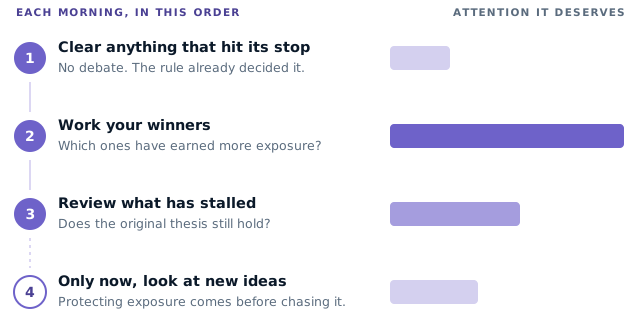
Most traders run this list upside down, starting with new ideas and getting to their open positions last.
Ready to put this into practice?
Everything from these four sessions is already built into the platform: watchlists, the Strategy Builder, the Risk and Investment Calculator, stop and take-profit alerts, and the Early Breakout Detector.
Open the platform →